
What Our Health Habits Tell Investors About the Next Generation of Demand
Younger consumers are drinking less, tracking more and embracing personalised health. What do these changing habits mean for investors and the growth of preventative healthcare?
By Jura Capital
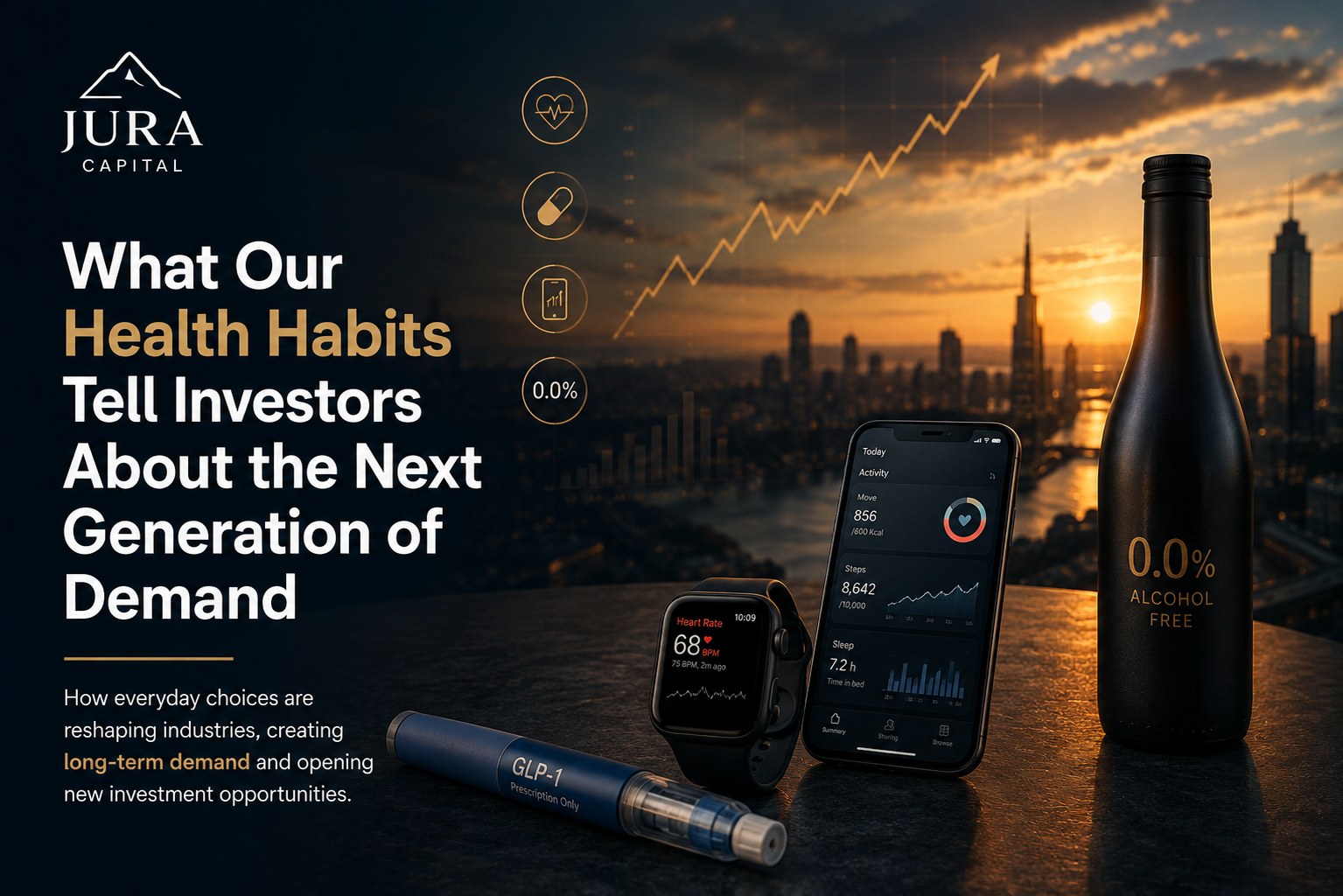
Every generation leaves clues about the markets it will create.
Sometimes they appear in what people buy. Sometimes they emerge through what people stop buying. More often, the most useful signals sit in the small decisions repeated every day: what we eat, how we exercise, whether we drink, what we measure and how actively we try to influence our future health.
Taken individually, these behaviours can look like passing consumer trends. A smart ring here, a non-alcoholic drink there, another fitness platform competing for attention. Viewed together, however, they suggest something more important. Health is moving from an occasional concern to a daily practice, and from something largely managed after a problem appears to something consumers increasingly want to understand, monitor and influence in advance.
For investors, the opportunity is not simply the growth of “wellness”. That label has become broad enough to include everything from gym memberships to skincare, supplements and meditation retreats. The more interesting question is whether a durable category is forming around personalised prevention: products and platforms that can convert health data into relevant guidance, encourage action and demonstrate whether behaviour is producing measurable change.
Younger consumers are rewriting the social rules around health
One of the clearest examples can be found in alcohol.
For much of the past century, drinking was deeply embedded in British social life. Choosing not to drink often required an explanation; increasingly, moderation is becoming a product category and a social identity in its own right. The Drinkaware Monitor 2025 found that 49% of young adults were choosing no- and low-alcohol drinks to moderate their consumption, up from 28% in 2018. Across UK adults, frequent drinking, weekly binge drinking and drinking above the Chief Medical Officers’ low-risk guidelines were all lower than in 2018.
The long-term public-health data points in the same direction. The Chief Medical Officer’s annual report for 2025 noted that high-risk drinking, which was more prevalent among young adults in 1996, had become more common among older adults by 2022, describing this as a cohort effect likely to persist. The proportion of 15-year-olds reporting alcohol consumption in the previous week has also fallen.
This does not mean alcohol is disappearing, nor that every young person is becoming healthier. It means the default is changing. Moderation has become more visible, more socially acceptable and better served by products designed around choice rather than abstinence alone. Once a behaviour becomes easier to adopt and easier to signal, it can spread through friendship groups and households. Drinkaware found that 57% of people who knew somebody trying to cut back said it had affected their own drinking in some way.
That is how cultural change often compounds. Behaviours do not need to be biologically inherited to pass between generations. Children grow up around household norms; friends influence one another; products make new routines more convenient; repeated choices gradually alter what feels ordinary. For investors, this matters because demand can deepen long after the original trend has stopped feeling new.
Moderation is becoming mainstream
Use of no- and low-alcohol drinks to moderate consumption
Young adults
+21 percentage points
All UK adults
Source: Drinkaware Monitor 2025. This measures the use of no- and low-alcohol products to moderate drinking, not total alcohol consumption.
Health is becoming something people measure
The same shift is visible in fitness. Exercise is no longer confined to a scheduled class or a visit to the gym. Steps, sleep, heart rate, recovery and training load can now be recorded throughout the day, turning previously invisible behaviour into feedback.
England’s latest Active Lives Adult Survey found that 64.6% of adults achieved at least 150 minutes of moderate-intensity activity a week in the year to November 2025, a record high, with around two million more adults active than in 2015 to 2016. The Government’s 10 Year Health Plan for England adds another revealing data point: by early 2024, around two-thirds of people surveyed were tracking at least one aspect of their health through an app or device, and the plan expects wearables to become standard within preventative, chronic and post-acute NHS care by 2035.
The significance is not the device itself. Consumer technology is crowded, and novelty rarely guarantees retention. What matters is the expectation the device creates: people become accustomed to seeing their health expressed as information, comparing the present with the past and receiving prompts based on their own data.
That expectation is changing the standard against which other health products are judged. Generic advice, whether that is sleep more, move more or eat better, may still be correct, but it is rarely sufficient to sustain engagement. Consumers increasingly want to know what matters to them, what they should do next and whether it is working.
McKinsey’s 2025 Future of Wellness survey of more than 9,000 consumers across the UK, US, China and Germany described wellness for millennials and Generation Z as a daily, personalised practice rather than a set of occasional purchases. In the UK, 79% of consumers said wellness was an important or top priority. Younger consumers also bought across a wider range of discretionary categories, including health-tracking devices and digital services.
There is an important caution here. Measurement can create false precision, and a dashboard is not the same thing as a clinically useful insight. Products that collect sensitive information must earn trust, explain limitations and protect data appropriately. The companies most likely to build lasting value will not necessarily be those generating the greatest volume of data, but those able to turn reliable information into action without overstating what it can prove.
From intention to measurement
Prevention is becoming a daily practice
64.6%
of adults achieved 150 or more minutes of moderate activity a week
England, 2024 to 2025
2 in 3
of those surveyed tracked at least one aspect of their health with an app or device
UK, early 2024
79%
of consumers described wellness as an important or top priority
UK, 2025
Sources: Sport England Active Lives Adult Survey 2024 to 2025; 10 Year Health Plan for England; McKinsey Future of Wellness 2025. Three separate evidence points rather than a comparable series.
GLP-1 medicines have changed more than weight management
Few developments illustrate the move towards active health management more clearly than the rise of GLP-1 medicines.
These treatments have changed the commercial conversation around obesity, but their wider importance lies in the ecosystem forming around them. In England, 29% of adults are living with obesity and 64% with overweight or obesity. NHS England’s phased implementation of tirzepatide identifies an initial cohort of approximately 220,000 people over its first three years, from a much larger clinically eligible population.
This is not a straightforward consumer trend. GLP-1 medicines are prescription treatments with eligibility criteria, side effects and a need for clinical oversight. They should not be treated as lifestyle accessories. Yet their adoption shows how quickly behaviour can change when an intervention produces an outcome people can see and measure.
It also creates demand beyond the medicine itself. People losing weight may need support around nutrition, muscle retention, exercise, adherence and long-term habit formation. McKinsey’s 2025 research noted that the GLP-1 ecosystem was already creating momentum for protein- and nutrient-fortified foods, gut-health products and exercise programmes focused on maintaining muscle mass.
The investor lesson is broader than pharmaceuticals. When a major intervention changes consumer behaviour, the surrounding infrastructure often becomes valuable too. The opportunity can extend to diagnostics, monitoring, coaching, nutrition, fitness and services that help people understand their progress. The medicine may initiate change; an ecosystem develops around helping that change endure.
The GLP-1 ecosystem
One intervention, multiple areas of demand
STEP 1
GLP-1 adoption
STEP 2
Weight reduction and lower calorie intake
STEP 3
New support needs
Adjacent areas of demand
Nutrition, protein and fortified foods
Muscle maintenance and exercise
Adherence and coaching
Monitoring and long-term habit formation
NHS England plans phased tirzepatide access for approximately 220,000 eligible patients during the first three years. This is an initial commissioning cohort, not total UK demand or the current number of users.
Sources: NHS England interim commissioning guidance for tirzepatide; McKinsey Future of Wellness 2025. The adjacent categories are an investor interpretation of observed consumer needs, not a forecast of guaranteed market growth.
Intention is abundant, useful feedback is scarce
Consumers are not short of health advice. They are surrounded by it.
The Food Standards Agency’s latest Food and You 2 survey found that 75% of respondents in England, Wales and Northern Ireland had made at least one change to their eating habits for health reasons during the previous year. Among those reporting a change, 49% had eaten less processed food, 48% had reduced high-sugar foods and drinks, and 46% had eaten more fruit and vegetables.
Self-reported intentions do not always translate perfectly into purchasing or better outcomes. The Agency itself notes that household purchasing data presents a more mixed picture. That gap between wanting to change and sustaining change is precisely why the category is commercially interesting.
Advice becomes more useful when it is specific enough to act upon and when progress can be observed. This helps explain the convergence now taking place between testing, wearables, coaching, nutrition and personalised recommendations. Each addresses a different part of the same problem:
- What is happening in my body?
- Which actions are most relevant to me?
- How can I make those actions part of everyday life?
- Is the intervention producing a meaningful change?
A company able to answer only the first question may sell a test. A company able to connect all four has the beginnings of a platform.
The emerging category is personalised prevention
The category taking shape sits somewhere between consumer wellness and conventional healthcare.
It is more evidence-led than generic lifestyle content, but it should not be confused with diagnosis or clinical treatment. It uses individual data to make prevention more relevant, while relying on repeat engagement to turn information into behaviour. Its products may include tests, apps, wearables, coaching and nutritional interventions, but the underlying proposition is consistent: understand more, act earlier and measure what changes.
Policy is beginning to move in the same direction. The 10 Year Health Plan is organised around three shifts: hospital to community, analogue to digital, and sickness to prevention. It explicitly identifies data, AI, genomics and wearables as technologies that could support more predictive and personalised care. Policy ambitions do not guarantee commercial success, but they do indicate that personalised prevention is moving beyond a consumer niche and into the design of future health systems.
For investors, the attractive businesses in this category will need more than an interesting test or a well-designed app. They will need scientific credibility, careful claims, trusted data governance and evidence that customers remain engaged after the first result arrives. Distribution will matter as much as technology. Employers, clinics, laboratories, insurers and established health brands may ultimately provide more efficient routes to scale than direct-to-consumer marketing alone.
The personalised prevention loop
From health data to sustained behaviour
The commercial opportunity lies in connecting the stages, rather than serving only one of them.
Where Muhdo fits
One company operating within this emerging category is Muhdo Health.
Muhdo combines saliva-based DNA and epigenetic testing with personalised reports and an AI-supported health coach called MAISIE. The DNA test is intended to provide information about inherited predispositions, while the epigenetic test examines changeable markers associated with lifestyle and environmental influences. The platform then connects those results with guidance relating to areas such as nutrition, exercise, sleep and recovery.
The distinction between fixed information and changeable information is important to the proposition. A genetic result may help somebody understand their baseline; epigenetic retesting is intended to offer a way of observing whether selected markers change over time. Muhdo’s broader model also extends beyond a consumer test kit through corporate wellbeing applications, a partner portal, white-label options and API integration for clinics, laboratories and other health providers.
That does not remove the questions investors should ask. Scientific claims must be appropriately validated. Engagement and retesting need to be demonstrated in practice. Data security is fundamental when genetic and health information is involved. Research relationships are valuable when they strengthen evidence or translate into commercial capability, not simply because an institution’s name appears in a presentation.
But the reason Muhdo is relevant is larger than any one feature. It reflects the direction in which consumer expectations appear to be moving: from generic recommendations towards personal information, from one-off advice towards ongoing guidance, and from good intentions towards measurable action.
What investors should watch next
Behavioural shifts rarely develop in a straight line. Some health products will prove faddish. Consumers will abandon devices that create work without providing value. Regulators will rightly challenge exaggerated claims, and the line between wellness guidance and medical advice will remain important.
Even so, the underlying direction is becoming difficult to ignore. Younger consumers are moderating alcohol, treating fitness as part of identity, experimenting with digital health tools and expecting greater personalisation. GLP-1 medicines have demonstrated the scale of latent demand for interventions that can produce visible outcomes. Government policy is placing prevention, genomics, data and wearables closer to the centre of future healthcare.
The next generation of demand may therefore favour companies that can do three things well: establish a credible personal baseline, translate information into an action somebody can realistically follow, and provide feedback that helps the behaviour continue.
The opportunity is not simply to help people know more about their health. It is to help them do something useful with what they know.
Join the Muhdo investor webinar
Jura Capital will be joined by Muhdo Health for a live investor webinar exploring the growth of personalised prevention, Muhdo’s product platform and the commercial opportunity behind changing health behaviour. The session will include a live discussion and an opportunity to put questions directly to the company.
Reserve your place for the Muhdo investor webinar
Referenced research and data sources
- Chief Medical Officer’s Annual Report 2025: Health trends and variation in England
- Drinkaware Monitor 2025
- Food Standards Agency: Food and You 2, Wave 11
- McKinsey: The Future of Wellness 2025
- NHS England: Interim commissioning guidance for tirzepatide
- Sport England: Active Lives Adult Survey 2024 to 2025
- UK Government: 10 Year Health Plan for England
This article is for information only and does not constitute investment, tax or medical advice. Private-market investments are high risk and illiquid. Capital is at risk.