
The Best Investments Rarely Start As Headlines
Why long-term value is often created by solving enduring problems, not chasing the loudest trends.
By Jura Capital
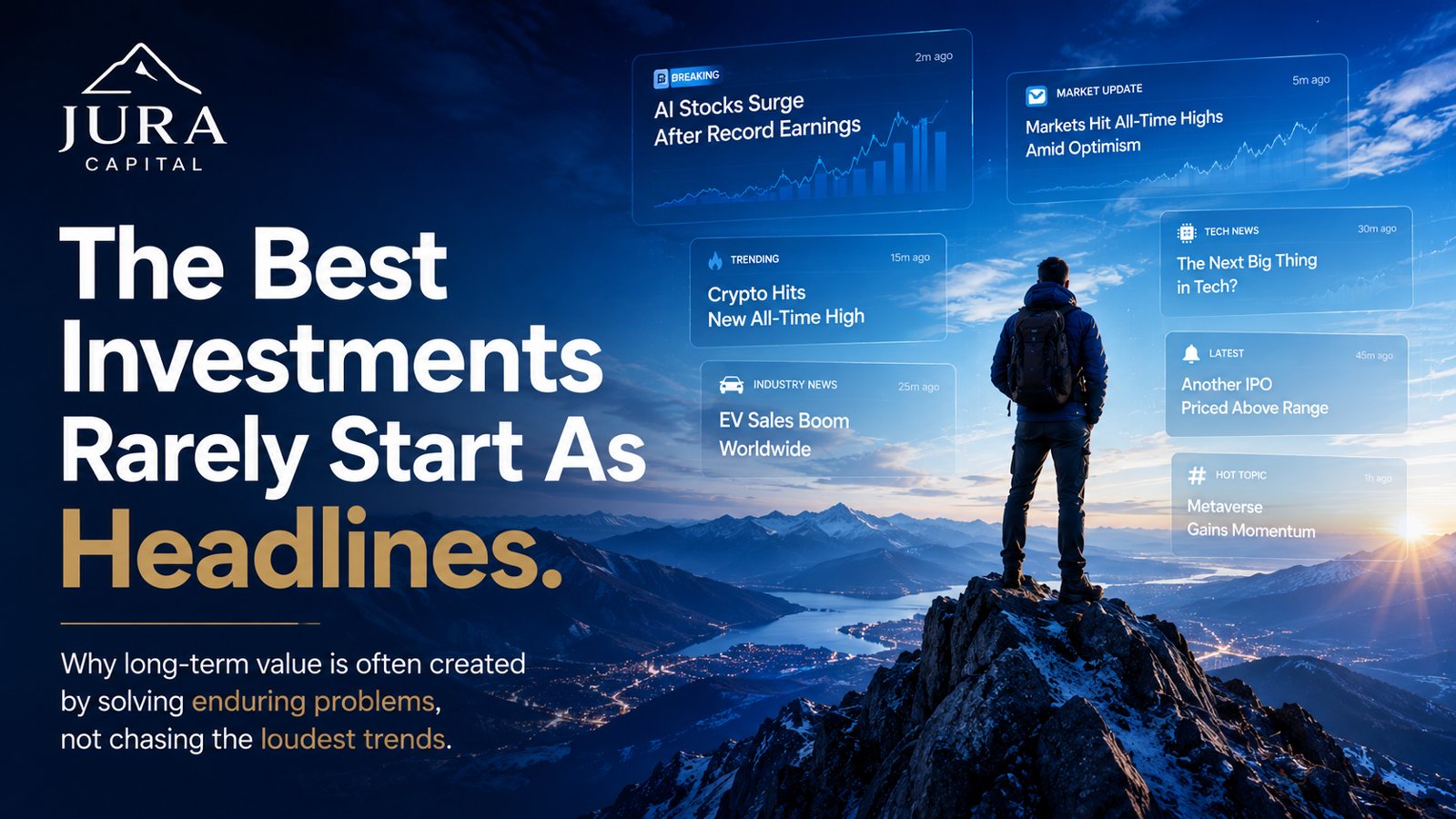
Every investment cycle seems to arrive with its own cast of certainties. Today, it is artificial intelligence. Before that, it was electric vehicles. Before that, cryptocurrencies, NFTs, cannabis stocks, SPACs, and a seemingly endless stream of sectors that promised to reshape the future. Some went on to create enormous value. Others generated more headlines than shareholder returns.
The challenge for investors is that visibility and value are not the same thing. In fact, they often have very little to do with one another. For institutional allocators and private investors alike, sustainable wealth is built by looking past the near-term noise and focusing on fundamentals.
The attention economy vs. real value
We live in a world where attention has become one of the most valuable commodities on earth. More than fifty years ago, Nobel Prize-winning economist Herbert Simon observed that “a wealth of information creates a poverty of attention”. That observation feels more relevant today than ever. Information is abundant. Attention is scarce.
Every day, companies compete not only for customers and market share, but for clicks, impressions, mentions, and mindshare. Total global data volume is expanding exponentially, compounding the sheer amount of noise that investors must filter through daily, as highlighted in recent PwC industrial tech forecasts. News travels instantly; opinions travel faster. Narratives can be created, amplified, and repeated across thousands of screens before most people have had their morning coffee.
Yet abundance creates its own problem. When every opportunity is presented as transformational, revolutionary, or once-in-a-generation, it becomes increasingly difficult to identify which ideas genuinely matter. The opportunities receiving the most attention are not necessarily the ones creating the most value. More often, they are simply the opportunities that are easiest to explain, easiest to share, and easiest to package into a compelling story.
That distinction matters because some of the world’s most successful investments were never particularly exciting to begin with.
The value of solving “boring” problems
Property provides a useful example. When we sit around a dinner party table, conversations are often filled with excitement about moving house, interior design, or climbing the property ladder. Yet the real underlying value of real estate has nothing to do with aesthetics or social trends. It is rooted in the universal, fundamental need for shelter — a requirement that does not discriminate by status or wealth. It is something everyone needs, and therefore the demand will always exist, especially within a growing population.
Markets fluctuate. Interest rates rise and fall. Governments change. Economic cycles come and go. Yet the baseline necessity for a place to live remains absolute. The investment case is not built on novelty. It is built on necessity.
Think of it like everyday infrastructure. Nobody gives a second thought to their boiler company until the heating breaks on a freezing winter morning. Nobody thinks about the electric grid until the lights suddenly go off. The same rule applies to utilities, telecommunications networks, logistics, and healthcare systems. They rarely dominate social media conversations because they are not designed to capture mindshare. Their value comes entirely from solving problems that society cannot function without. We rarely appreciate the plumbing of the system until it faces a critical bottleneck.
Trends come and go. Structural shifts stay.
One of the most common mistakes investors make is confusing temporary trends with structural shifts. Trends attract short-term attention, but structural shifts permanently alter human behaviour. A trend may dominate headlines for six months; a structural shift changes how industries operate for decades.
A trend captures immediate market sentiment and drives near-term momentum. A structural shift quietly re-engineers infrastructure and supply chains, unfolding over multi-decade horizons.
The internet was not a trend. It fundamentally altered how information moved around the world. Mobile technology was not a trend. It changed how billions of people communicate, shop, and work. Cloud computing did not succeed because it was fashionable. It succeeded because it solved a growing enterprise data problem more effectively than the systems that came before it.
The largest opportunities often emerge when a structural shift collides with an unavoidable, structural human need. That is where healthcare becomes particularly interesting from an investment perspective.
The mathematics of an ageing population
Unlike many sectors currently attracting investor attention, healthcare does not need a compelling narrative to justify its existence. The demand is already there. In fact, it is growing at a predictable, mathematical pace.
Across developed economies, populations are ageing rapidly. According to data from the United Nations World Population Prospects, there are currently more than 760 million people aged 65 and over globally, with that figure projected to reach approximately 1.6 billion by 2050. In practical terms, the global population aged 65 and over is expected to more than double within the next 25 years. In major developed nations, senior citizens will soon account for more than a quarter of the total population, according to the latest OECD Health at a Glance.
This is not a prediction or a speculative trend forecast. It is mathematics. As a result, total healthcare spending as a percentage of GDP continues to outpace broader economic growth across Western economies, as tracked by the World Bank. The burden of chronic disease is increasing, and the demand for diagnostics, treatment, and monitoring is expanding along with it. Just like the electric grid or the home boiler, we don’t think about the system daily, but the underlying pressure moves relentlessly in one direction.
The rising economic burden of dementia
Few conditions sit more squarely at the centre of this demographic shift than Alzheimer’s disease and dementia. Unlike many abstract investment themes, Alzheimer’s is rarely a purely theoretical concept. Most people know somebody who has been affected by it — a parent, a grandparent, a neighbour, or a family friend.
While the emotional impact on families is profound, the economic consequences for global healthcare infrastructure are equally massive. According to the World Health Organization, more than 55 million people currently live with dementia worldwide. That figure is expected to rise to approximately 78 million by 2030 and 139 million by 2050 as the global population continues to age.
Dementia already costs the global economy an estimated US$1.3 trillion annually, and analysis by Alzheimer’s Disease International projects this figure will expand to US$2.8 trillion by 2030 as institutional care demands escalate. These figures matter to an investor because they represent guaranteed demand. This is not a market that requires consumer education, marketing adoption, or behavioural changes. The underlying challenge is already here, and it is growing every day.
The diagnostic bottleneck: hiding in plain sight
As populations continue to age, healthcare systems face severe pressure to identify and manage neurodegenerative diseases much earlier. At the same time, major pharmaceutical companies are investing billions into new therapies designed to intervene early in the disease progression, a trend highlighted by McKinsey Health Insights.
However, a major structural bottleneck blocks this progress: current diagnostic tools are completely unsuited for population-wide screening. Traditional identification relies on expensive, invasive, and low-throughput methods like Positron Emission Tomography (PET) scans and spinal fluid checks. Because of these constraints, research published by Alzheimer’s Disease International shows that up to 75% of individuals experiencing early dementia symptoms remain undiagnosed globally.
Clinical data profiles in The Lancet Neurology indicate that existing screening infrastructure can accommodate less than 10% of the eligible patient population in developed markets. This massive gap between therapeutic availability and diagnostic capacity is shifting the core value pool toward infrastructure: diagnostics, blood-based biomarkers, and scalable data interpretation tools.
Technology as a tool, not a headline
One company solving this problem is Tivenix, a Swiss health technology business focused on earlier Alzheimer’s detection through AI-powered biomarker analysis and blood-based diagnostics.
Importantly, what makes a business like Tivenix interesting is not simply that artificial intelligence forms part of the solution. The investment case does not rely on AI being a popular buzzword. If anything, relying on market hype is a fragile foundation on which to build a business or deploy long-term capital.
What matters is whether the underlying problem is real. Can healthcare systems benefit from identifying Alzheimer’s earlier? Can earlier intervention improve patient outcomes? Can scalable diagnostic tools reduce costs, improve clinical pathways, and support emerging therapies?
These are the operational questions that matter. Artificial intelligence is simply the tool being applied to solve them. This shifts the conversation away from technology for its own sake and back toward clinical utility. The strongest businesses are rarely those that adopt a new technology first; they are the businesses that apply technology to an unavoidable problem that genuinely needs solving.
Looking beyond the headlines
The businesses that create the greatest long-term value are rarely those that generate the most noise. More often, they are the businesses solving problems that continue to exist regardless of whether they are currently attracting attention.
In a market increasingly shaped by algorithms, headlines, and short-term narratives, it can be tempting to follow whatever is generating the most conversation. But history suggests wealth is rarely built by chasing attention alone. More often, it is built by identifying important, real-world problems before the wider market fully appreciates their significance. The most valuable opportunities do not always begin as headlines. Sometimes they begin as necessities hiding in plain sight.
Continuing the conversation
At Jura Capital, we focus on helping investors access institutional-grade private market opportunities positioned around long-term structural trends rather than short-term market narratives. If you would like to learn more about our evaluation of Tivenix, discuss the themes explored in this briefing, or explore other private market allocations, we would be delighted to hear from you.
Get in touch with our investment team →
References
- Alzheimer’s Disease International. (2024). World Alzheimer Report 2024. Link
- The Lancet Neurology. (2024). Infrastructural readiness for disease-modifying therapies in neurodegenerative conditions. Link
- McKinsey Health Insights. (2025). Capital flows in precision medicine and early diagnostics. Link
- OECD. (2025). Health at a Glance 2025: OECD Indicators. Link
- PwC. (2025). Technology Forecast: Navigating data saturation. Link
- Simon, H. A. (1971). Designing Organizations for an Information-Rich World. Johns Hopkins Press. Link
- United Nations. (2024). World Population Prospects 2024. Link
- World Bank. (2025). Global Healthcare Expenditure Database. Link
- World Health Organization. (2023). Global status report on the public health response to dementia. Link