Geopolitics produces endless headlines.
Markets react instantly.
Prices move reflexively.
Investors feel compelled to act.
Most of the time, that impulse does more harm than good.
The problem isn’t that geopolitics matters. It clearly does. The problem is how investors tend to engage with it – as if it were a tradeable signal rather than a structural condition.
In reality, geopolitics is rarely something to predict. It is something to design around.
Why geopolitics is the wrong place to seek precision
Markets are good at pricing information. They are much worse at pricing uncertainty.
Geopolitical events create exactly the kind of uncertainty markets struggle with: open-ended timelines, unclear outcomes, and second-order effects that take years to materialize. Trying to trade headlines assumes a level of precision that simply doesn’t exist.
This is why most attempts to “invest during global conflicts” end up being reactive rather than strategic.
Geopolitics is not a trade.
It is a constraint.
It reshapes how economies function, how capital flows, and how risk is distributed – slowly, unevenly, and persistently.
Where geopolitical risk actually shows up
The real impact of geopolitics rarely appears in daily market moves.
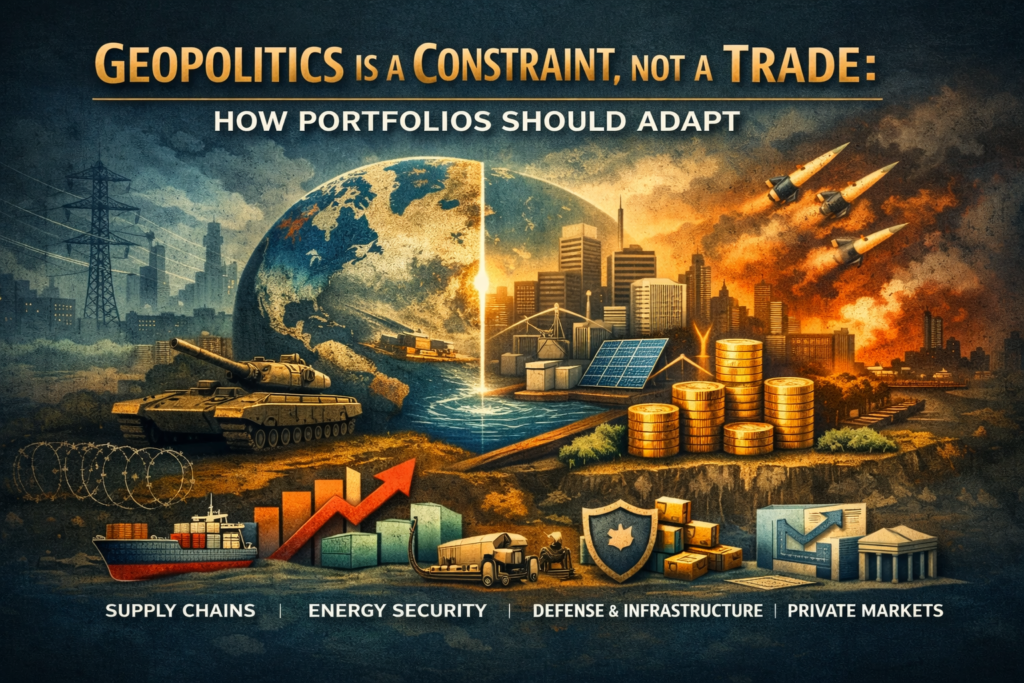
Instead, it emerges through structural changes such as:
- Reconfigured global supply chains
- Energy security and energy transition investment
- Increased defense and infrastructure spending
- Reshoring and near-shoring of critical production
- Reduced reliance on single-source efficiency
These forces operate over years, not weeks. They do not create neat entry and exit points. They create persistent investment conditions.
For high-net-worth investors, understanding this distinction is critical. The goal is not to forecast the next conflict or political shift. It is to build portfolios that remain resilient under geopolitical risk.
Investing during global uncertainty requires a mindset shift
One of the most common mistakes investors make during periods of global uncertainty is confusing activity with progress.
Reacting to every development creates churn, not resilience.
A more effective approach is to ask better questions – questions that accept uncertainty rather than fight it.
How portfolios should adapt
Rather than reacting to each geopolitical event, investors should step back and ask:
- What if global fragmentation persists longer than expected?
- Which assets benefit from redundancy rather than maximum efficiency?
- How does global fragmentation change supply chains and capital needs?
- Where does private capital adapt faster than public markets?
These questions reframe geopolitics from a source of anxiety into a portfolio design constraint.
Once framed this way, the objective becomes clearer: build exposure to areas that benefit from adaptation rather than prediction.
Why private markets matter more in a fragmented world
Many of the most meaningful geopolitical adjustments occur outside public markets.
Private markets often reflect these shifts earlier because they finance real economic change rather than price expectations. Infrastructure, logistics, energy systems, defense-adjacent industries, and domestic manufacturing capacity all tend to be funded privately before they appear fully in public indices.
This is why geopolitics and investing intersect more clearly in private markets than in short-term public market moves.
Reshoring investment opportunities, for example, are not about headlines – they are about long-term capital expenditure, labor realignment, and industrial policy that unfolds over decades.
These are slow-moving but durable trends.
Robustness beats prediction
For HNWIs, the most important portfolio question under geopolitical risk is not “What will happen next?”
It is:
Can my portfolio survive multiple plausible futures?
Portfolios designed for precision assume a narrow range of outcomes. Portfolios designed for robustness accept that uncertainty is structural – and that adaptability is the real edge.
This approach does not eliminate risk. It distributes it more intelligently.
Jura’s role: interpreting, not speculating
At Jura, we focus on translating macro forces into positioning that can live through multiple outcomes. Not because we claim to know how geopolitical events will unfold – but because we accept that uncertainty is not temporary.
This is the difference between being a macro speculator and a macro interpreter.
Rather than trying to time geopolitical shifts, we help investors position capital in ways that align with long-term structural change: diversification across geographies, exposure to real assets and infrastructure, and private market investments that benefit from resilience rather than efficiency.
When investors stop reacting, compounding resumes
Geopolitics will continue to generate headlines. Markets will continue to respond noisily. That will not change.
What can change is how portfolios are built.
When investors stop treating geopolitics as a trade, they stop overreacting. When they stop overreacting, decision-making improves. And when decision-making improves, compounding has room to work again.
In an uncertain world, the goal is not to eliminate volatility. It is to build portfolios that can endure it.
That is how investors adapt – not by predicting geopolitics, but by respecting it.