
AI Is Not an Asset Class - But It Is Reshaping Where Value Is Created
When new technologies emerge, investors instinctively try to package them into an asset class. That instinct is understandable - and usually wrong. We saw it with the internet. We saw it with mobile. And we are seeing it…
By Jura Capital
When new technologies emerge, investors instinctively try to package them into an asset class.
That instinct is understandable - and usually wrong.
We saw it with the internet. We saw it with mobile. And we are seeing it again with artificial intelligence. The rush to “get AI exposure” has created a familiar pattern: narrative dominance in public markets, excitement-driven valuations, and confusion about where long-term value is actually created.
AI is not something you simply buy exposure to.
It is not a sector, a style, or a single trade.
AI is a general-purpose force that redistributes value across industries.
Understanding that distinction is the difference between participating in a technological shift - and chasing its headlines.
Why AI resists simple categorization
Asset classes are useful because they group similar risk and return characteristics. AI does the opposite. It cuts horizontally across industries, business models, and value chains.
This is why framing AI as an “asset class” creates more confusion than clarity.
AI does not generate value on its own. It changes how value is created elsewhere - by lowering costs, increasing productivity, compressing timeframes, and altering competitive advantages.
For investors, this means the opportunity is not concentrated in a single place. It is distributed unevenly across layers of the economy.
Public markets capture excitement. Private markets capture economics.
In every major technological shift, public markets tend to capture the narrative first. Stocks move quickly, multiples expand, and expectations race ahead of fundamentals.
Private markets move differently.
They tend to capture the early economics: the infrastructure that must be built, the services that enable adoption, and the applied use cases that quietly reshape margins and workflows long before the story becomes obvious.
This distinction matters for high-net-worth investors who want AI exposure without narrative risk.
The question is not “Is AI a bubble or a structural trend?”
The answer is: it can be both - at different layers of the stack.
Investing through the AI value chain
Rather than trying to pick winners based on stories, a more durable approach is to invest through the AI value chain - focusing on where adoption creates measurable economic change.
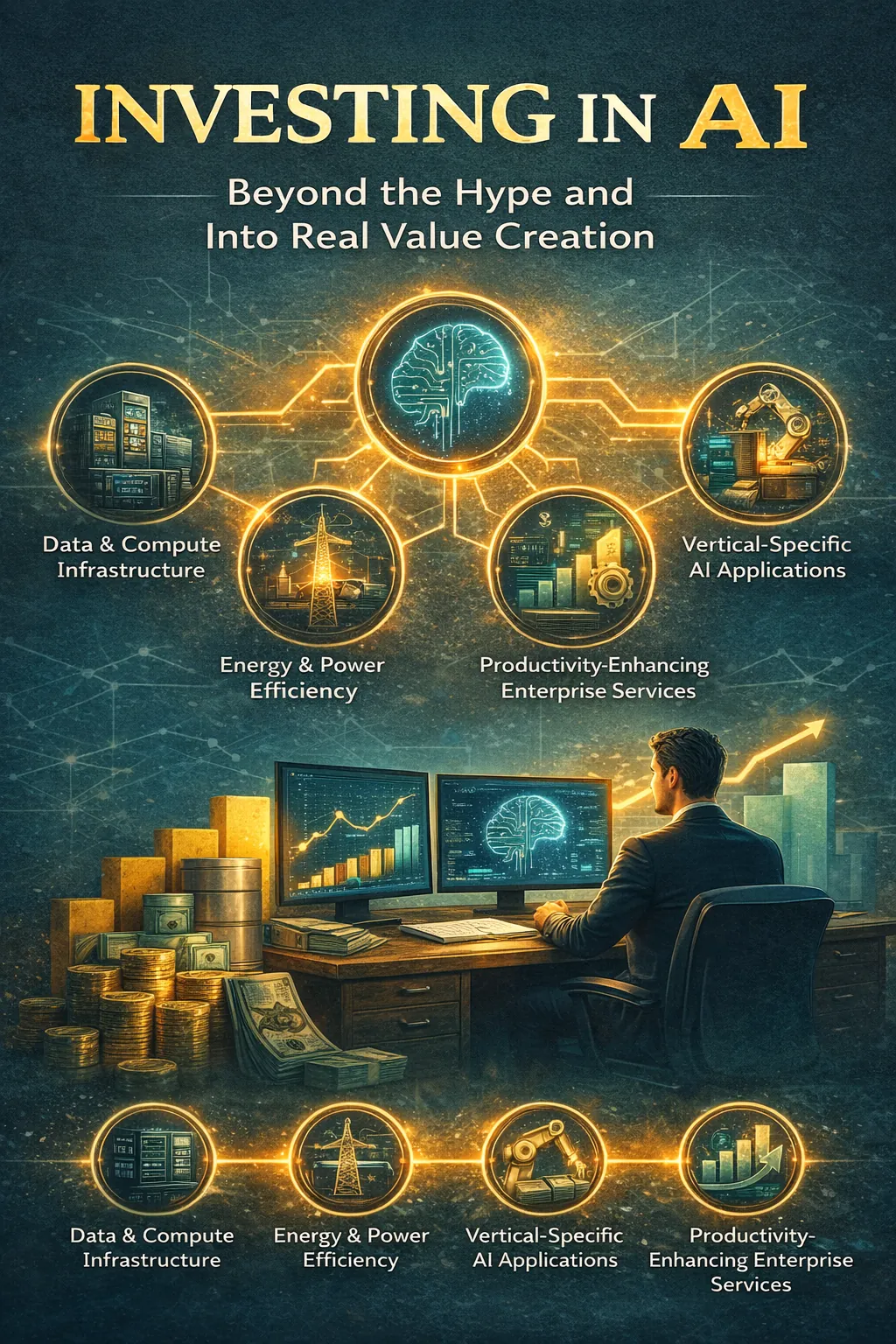
For investors seeking AI exposure beyond public stocks, the opportunity often lies across four broad areas:
1. Data and compute infrastructure
AI systems are only as powerful as the infrastructure behind them. Data centers, storage, networking, and compute capacity are foundational - and capital intensive.
These investments rarely feel exciting, but they are essential. Without them, AI adoption stalls. This makes infrastructure one of the most durable ways to access AI’s long-term growth.
2. Energy and power efficiency
AI is energy-hungry.
As compute demand grows, so does the need for reliable, efficient power. This creates investment opportunities in energy generation, grid modernization, cooling systems, and efficiency technologies that support AI at scale.
Here, AI’s impact on private markets is indirect but powerful: it accelerates capital spending in areas that already matter economically.
3. Vertical-specific AI applications
The most meaningful value from AI often emerges in narrow, industry-specific use cases.
Healthcare, logistics, manufacturing, financial operations, and professional services are seeing AI embedded into workflows that reduce costs, improve accuracy, and increase throughput.
These are not speculative ideas. They are applied solutions with measurable ROI - and they are often developed and scaled in private markets long before reaching public ones.
4. Productivity-enhancing enterprise services
AI’s most immediate economic impact is productivity.
Tools that automate repetitive tasks, enhance decision-making, and compress execution time change cost structures quietly but profoundly. For private equity investors, this directly affects margins and scalability across portfolio companies.
This is where AI stops being a technology story and becomes a business model story.
Avoiding the binary thinking trap
One of the biggest mistakes investors make is framing AI as either a bubble or a revolution.
That framing is too simplistic.
Technological transitions are rarely uniform. They create excess in some areas and durable value in others - often at the same time.
The role of capital is not to decide whether AI is “real,” but to identify where economics improve sustainably, independent of market sentiment.
Why private equity plays a unique role
Private equity allows investors to engage with AI where it actually changes business fundamentals - not just where it dominates headlines.
In private markets, AI is evaluated based on its impact on costs, efficiency, scalability, and competitive positioning. It is integrated into operating models rather than traded as a theme.
This makes private market exposure to AI particularly attractive for HNWIs seeking long-term participation without short-term volatility driven by narrative cycles.
AI as a lens, not a bet
AI is not a bet on technology.
It is a lens through which future value creation must be evaluated.
The most effective investors will not ask, “How do I buy AI?”
They will ask, “Where does AI quietly change economics?”
Those changes will not always be obvious. They will not always be labeled “AI.” But over time, they will shape margins, productivity, and competitive advantage across the global economy.
And that is where enduring investment value is created.