A Structural Upgrade in How Sophisticated Investors Assess Risk, Opportunity and Conviction
Private markets have always rewarded access, judgement and patience.
But as deal complexity increases and data volumes expand exponentially, one question has become central for serious allocators:
How can we improve decision quality without increasing blind spots?
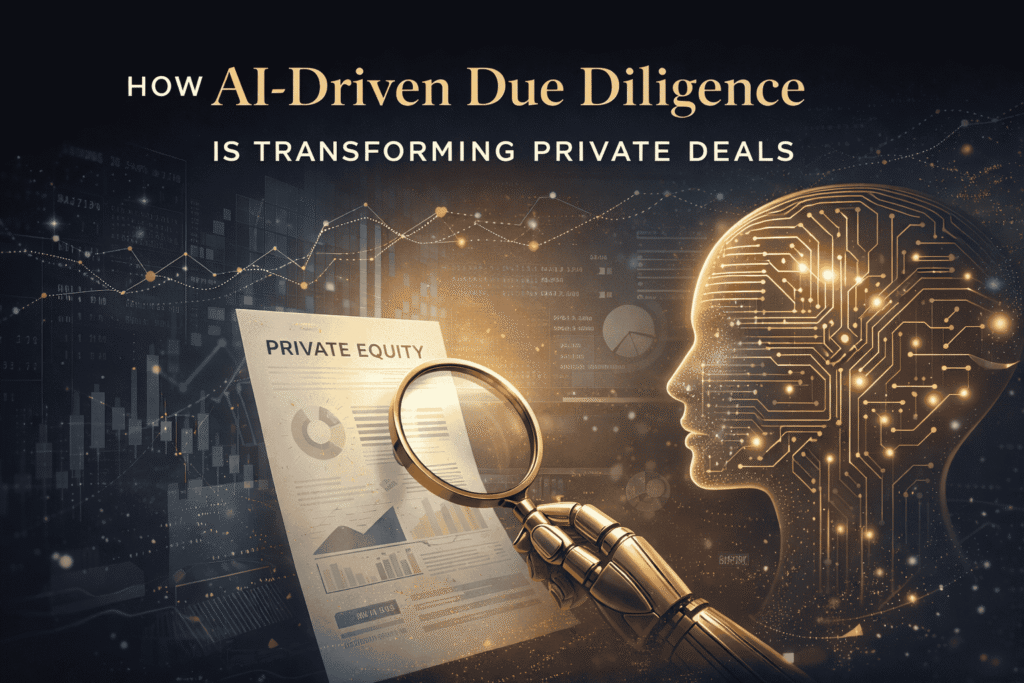
This is where AI due diligence in private equity and broader artificial intelligence private markets capabilities are quietly reshaping the landscape.
Not through hype.
Not through automation replacing judgement.
But through structural augmentation of investor intelligence.
For HNWIs and family offices allocating meaningful capital, this shift matters.
The Reality: Due Diligence Has Become More Complex
Today’s private deals involve:
- Cross-border structures
- Multi-layered capital stacks
- Regulatory overlays
- Operational data across jurisdictions
- Increasing ESG and compliance requirements
Traditional due diligence models – however thorough – are often:
- Time intensive
- Linear
- Human bandwidth constrained
- Dependent on sampling rather than full-spectrum analysis
For investors deploying significant capital, the risk is not lack of effort.
It is informational blind spots.
What Is AI Due Diligence in Private Equity?
When investors search for “AI due diligence private equity”, they are typically referring to the application of:
- Machine learning investment research
- Pattern recognition across large data sets
- Predictive analytics
- Automated anomaly detection
- Natural language processing across legal and operational documents
In practice, AI-driven due diligence enhances three core areas:
1. Data Depth
Instead of reviewing selected financial statements or limited operational metrics, artificial intelligence systems can:
- Analyse full transaction histories
- Detect irregular revenue patterns
- Flag margin inconsistencies
- Compare performance across peer datasets
2. Speed Without Superficiality
AI models process thousands of variables in minutes, allowing advisors and investment committees to focus on:
- Interpretation
- Scenario analysis
- Strategic judgement
Speed is not the objective.
Clarity is.
3. Risk Pattern Recognition
Machine learning in investment analysis identifies patterns that human review might overlook:
- Correlation risks
- Customer concentration vulnerabilities
- Supply chain fragility
- Historical volatility clusters
The result is not certainty — but improved probability assessment.
How AI Improves Investment Decision Making
HNWIs and family offices are not seeking automation.
They are seeking:
- Better signal-to-noise ratio
- More robust downside protection
- Institutional-grade decision frameworks
Artificial intelligence improves investment decision making in three structural ways:
1. Expanding the Analytical Surface Area
Traditional due diligence often reviews representative samples.
AI tools can review entire datasets.
This reduces dependence on selective review and increases data integrity.
2. Enabling Comparative Intelligence
AI systems can benchmark:
- Target companies against thousands of peers
- Cost structures across industries
- Performance metrics across cycles
This enhances institutional-grade deal sourcing Europe-wide and globally.
3. Stress Testing at Scale
Scenario modelling becomes more dynamic.
Rather than static sensitivity tables, AI-driven systems simulate:
- Macroeconomic shifts
- Rate environment changes
- Demand shocks
- Liquidity stress
For HNWIs concerned with capital preservation, this depth of modelling matters.
Why This Matters to Family Offices and Sophisticated Allocators
Family offices often face a structural challenge:
They must operate with institutional rigour — but without the full infrastructure of a pension fund.
AI-enhanced due diligence allows:
- Smaller teams to operate at institutional-grade analytical depth
- Independent verification of sponsor assumptions
- Reduced reliance on marketing narratives
This is particularly relevant when evaluating:
- Private equity growth strategies
- Structured credit vehicles
- Cross-border private investments
- Technology-driven scale-ups
For investors seeking alternative investment advisory for family offices, this capability is increasingly expected.
The Swiss Context: Precision and Governance
Switzerland’s reputation in private wealth management is built on:
- Stability
- Precision
- Regulatory integrity
- Long-term capital stewardship
In this environment, the integration of AI due diligence does not replace governance — it strengthens it.
A private investment advisory firm Switzerland-based that incorporates AI-enhanced analysis signals:
- Institutional discipline
- Commitment to risk transparency
- Forward-thinking methodology
For investors evaluating private equity due diligence services Switzerland, the question is no longer whether AI is used — but how intelligently it is integrated.
AI Is Not Replacing Human Judgement
A critical distinction must be made.
AI does not replace:
- Investment committees
- Manager relationships
- Sector expertise
- Experience-based intuition
Instead, it enhances professional private market deal analysis by:
- Filtering noise
- Highlighting anomalies
- Quantifying patterns
- Reducing cognitive bias
Human judgement remains central.
But it becomes better informed.
Where AI-Driven Due Diligence Has the Greatest Impact
1. Deal Sourcing
Artificial intelligence private markets tools can scan:
- Thousands of company profiles
- Sector growth trends
- Acquisition histories
- Market dislocations
This strengthens institutional-grade deal sourcing Europe and beyond.
2. Financial Forensics
Machine learning investment research detects:
- Revenue smoothing
- Margin manipulation patterns
- Cost inflation irregularities
- Inconsistent working capital cycles
For serious allocators, early detection reduces asymmetric downside.
3. Operational Risk Assessment
AI models assess:
- Customer concentration exposure
- Supply chain dependency
- Vendor fragility
- Regulatory sensitivity
This level of depth supports more robust capital deployment decisions.
The Strategic Advantage for HNWIs
HNW investors allocating into private markets increasingly seek:
- Transparency
- Process sophistication
- Downside discipline
- Institutional comparability
AI-driven due diligence provides:
- Enhanced analytical depth
- Structured decision frameworks
- Scalable evaluation models
- Improved risk identification
This aligns with the needs of:
- Multi-generational families
- Entrepreneurial investors
- Global allocators
- Cross-border capital structures
It transforms private market evaluation from reactive review to predictive assessment.
Key Questions Sophisticated Investors Should Ask
When engaging with advisors or sponsors, consider:
- What analytical tools are used in due diligence?
- How are large datasets reviewed?
- How are risks stress-tested?
- Is machine learning used to benchmark performance assumptions?
- How is bias mitigated in investment committees?
These questions distinguish surface-level review from institutional-grade process.
Final Thoughts: Intelligence as a Structural Edge
Private markets remain relationship-driven and experience-based.
However, the informational complexity of modern deals requires upgraded tools.
AI due diligence private equity is not a marketing label.
It represents:
- Expanded analytical depth
- Reduced informational blind spots
- Enhanced risk detection
- More disciplined capital allocation
For HNWIs and family offices seeking robust private equity due diligence services Switzerland and broader professional private market deal analysis, the integration of artificial intelligence signals structural maturity.
In private markets, access creates opportunity.
Process protects capital.
AI enhances process.
And in an environment where conviction must be backed by data, that distinction matters.