Most people think about risk when markets are already falling. By then, it’s too late.
The job of a Chief Investment Officer isn’t to predict the future. It’s to prepare for many plausible futures-and to build a portfolio that can survive, and ideally compound, across all of them. That mindset is available to anyone willing to think clearly, systematically, and without emotional attachment to recent experience.
Stress-testing your wealth is not about pessimism. It’s about realism. History shows that the biggest losses don’t come from what we expect, but from what we failed to imagine.
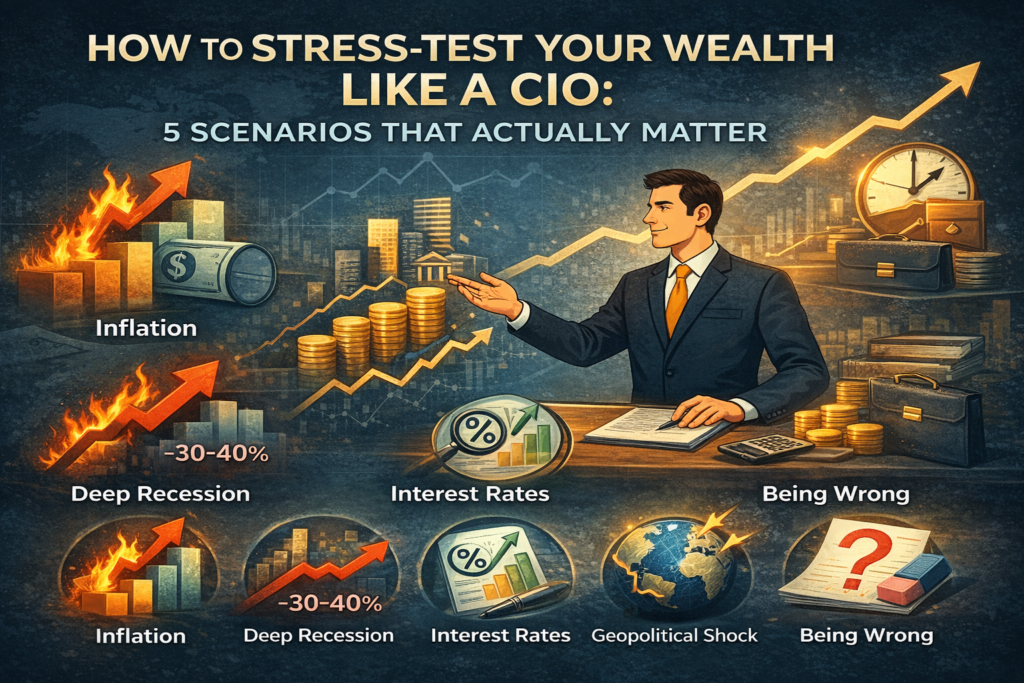
Below are five scenarios that actually matter-because they show up again and again in different forms-and how to think about your portfolio through each one.
1. Inflation Stays Higher Than You’re Comfortable With
Inflation is not a short-term phenomenon; it’s a monetary one. When too much money chases too few real goods, purchasing power erodes-sometimes slowly, sometimes suddenly.
The mistake most investors make is focusing on nominal returns. What matters is real returns-what your wealth can actually buy.
Stress test question:
If inflation runs at 4–6% for several years, which parts of my portfolio are quietly losing purchasing power?
What tends to struggle
– Long-duration bonds
– Cash held beyond true liquidity needs
– Fixed income streams without inflation adjustment
What tends to help
– Assets linked to real economic activity
– Pricing power
– Inflation-sensitive instruments
The goal isn’t to “beat inflation” every year. It’s to avoid being structurally exposed to it.
2. A Deep Recession Hits at the Same Time as Market Losses
Recessions are not just market events; they are income events. People lose jobs. Businesses lose revenue. Liquidity suddenly matters more than return.
This is where theoretical asset allocation meets real life.
Stress test question:
If my income drops sharply and markets fall 30–40%, what am I forced to sell?
Forced selling is the enemy of compounding. CIOs design portfolios so that survival never depends on perfect timing.
What to examine
– Emergency liquidity (in time, not just dollars)
– Concentration in income-dependent assets
– Debt obligations relative to stable cash flow
If you have to sell your best assets at the worst time, the plan wasn’t robust enough.
3. Interest Rates Stay Higher for Longer
Many portfolios were built during a multi-decade period of falling rates. That tailwind is gone-at least for now.
Higher rates change the math of everything: valuations, leverage, refinancing risk, and opportunity cost.
Stress test question:
Which assets in my portfolio only work if rates come down?
Common vulnerabilities
– Highly leveraged investments
– Long-duration growth assets priced on distant cash flows
– Businesses dependent on cheap refinancing
Higher rates reward patience and discipline. They punish excess and financial fragility.
4. A Geopolitical Shock Freezes Parts of the System
Geopolitical risk isn’t about headlines-it’s about discontinuities. Supply chains break. Capital controls appear. Markets stop functioning normally.
These events are rare, but when they happen, diversification that looks good on paper often fails in practice.
Stress test question:
If capital is restricted, markets are closed, or correlations spike, what actually protects me?
Think beyond
– Single-country exposure
– One financial system
– One legal or regulatory framework
True diversification is about different drivers, not just different tickers.
5. You Are Wrong About Something Important
This is the most overlooked scenario.
Every investor has blind spots. The biggest risks usually sit where confidence is highest and questioning is lowest.
Stress test question:
If my core assumptions are wrong, how bad does it get?
CIOs don’t ask, “What do I believe?”
They ask, “What if I’m wrong-and how do I survive it?”
Practical discipline
– Avoid concentrated bets that require being right
– Balance offense with defense
– Build in margins of safety
Humility is not a personality trait-it’s a risk management strategy.
Robustness Over Brilliance
The best portfolios don’t rely on a single outcome. They are designed like systems-capable of bending without breaking.
Stress-testing your wealth isn’t about adding complexity. It’s about asking better questions:
– Where am I fragile?
– Where am I assuming the future looks like the past?
– Where would I regret not having prepared?
You don’t need to forecast the next crisis to survive it. You need a structure that acknowledges uncertainty and respects history.
In the long run, the investors who do best are not the most confident or the most clever. They are the ones who build portfolios that can endure reality-whatever form it takes.